Confidential document destruction and paper recycling
How international companies in Mexico can destroy payroll files, invoices and archived records securely, align local rules with corporate retention policies and make sure shredded paper gets recycled.
By Zikloa TeamPublished 5 min read
Key takeaway: Confidential document destruction protects your company, your customers and your employees when paper records reach the end of their useful life. What matters is an unbroken chain of custody, from locked bin to destruction certificate, and making sure the shredded paper is recycled rather than landfilled.
Every operation in Mexico generates paper that carries sensitive information: payroll, contracts, invoices, engineering drawings, price lists, customs paperwork. When those records are no longer needed, the easy options are the trash bin or the office shredder. Neither is secure at scale, and neither leaves the evidence your compliance team will eventually ask for.
Confidential document destruction solves both problems. It makes the information unrecoverable and turns the paper into raw material for the paper industry. For international companies, there is an extra layer: aligning Mexican requirements with a global records retention schedule written for another jurisdiction. Here is how to set it up properly.
Which records need secure destruction?
As a rule of thumb, anything containing personal data, financial information or business know-how:
- Personnel files, payroll records, medical leave and health documents.
- Invoices, bank statements, reconciliations and accounting records.
- Contracts, agreements and legal correspondence.
- Drawings, specifications, process sheets and formulations.
- Price lists, customer databases and quotations.
- Foreign-trade and customs records, if you operate under an IMMEX program.
- Archived records whose retention period has expired.
Before destroying any archive, confirm with legal, tax, HR and, where relevant, your customs broker that the applicable Mexican retention period has ended. Corporate retention schedules drafted for the US or Europe do not always match local periods, so have your legal team reconcile both before anything is shredded.
Why the trash bin and office shredders fall short
A document thrown away intact can end up in anyone's hands. Mexico's law on personal data held by private parties requires companies to safeguard personal information throughout its life cycle, and that includes its disposal. Drawings or pricing in the wrong hands are also a competitive risk, especially in industrial clusters where suppliers and competitors share the same parks.
Office shredders are not built for volume either:
- They are slow and tie up staff with higher-value work to do.
- Many entry-level units cut in strips that can be reassembled.
- Shredded paper often ends up mixed with general trash and is never recycled.
- They leave no record of what was destroyed, when or by whom.
One point that often gets missed: hard drives, USB sticks, discs and devices that store data should never go into the paper stream. They need secure wiping or a different kind of physical destruction and are managed as electronic waste. Our guide to e-waste recycling for circuit boards and obsolete equipment explains how to handle them.
How a secure process works, step by step
A professional service is built on chain of custody: at no point is the document exposed to unauthorized people. A typical flow:
- Locked consoles or bins in offices and admin areas, where staff deposit paper they cannot retrieve.
- Scheduled pickup by identified personnel, who move the containers or their contents in an enclosed vehicle.
- Logging and weighing of the material, with a reference number tied to your company.
- Destruction by industrial shredding.
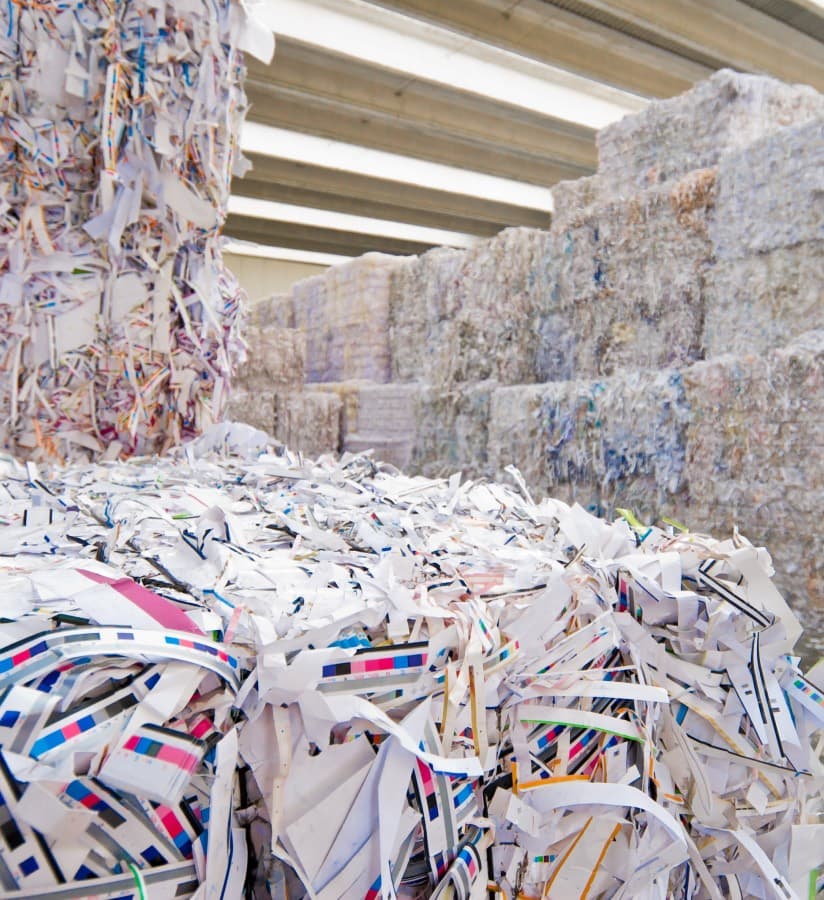
- Recycling of the shredded paper, which is pulped to make new paper or board.
- Delivery of a certificate of destruction with the service details.
On-site or off-site: how to choose
There are two main service models, and each has its place:
| Model | Advantages | Considerations |
|---|---|---|
| On-site destruction | You can witness it; paper leaves your site already shredded | Needs space and access coordination at your plant or office |
| Off-site destruction at the provider's facility | Handles large volumes with less disruption to your operation | Chain of custody during transport must be well documented |
The right choice depends on how sensitive the information is, your volume and what your global policy requires. Daily office paper usually works well with a tightly controlled off-site flow; one-off purges of highly sensitive files are where some companies prefer to witness destruction.
Shred size and what it means for recycling
Not all shredding is equal. The German standard DIN 66399, widely used as an international reference, rates paper shredding security from P-1 to P-7: the higher the level, the smaller the particles and the harder it is to reconstruct the information.
Shredded paper is still recyclable, but the finer the cut, the harder it is to handle and the lower the grade it usually trades at. Reserve high security levels for records that truly need them and send ordinary office paper to standard recycling. If your team is unsure what can go straight to recycling, our guide to what paper can and can't be recycled is a good starting point.
What your certificate of destruction should include
The certificate is your evidence for internal audits, customers and authorities. Check that it shows at least:
- Your legal entity name and site address.
- Pickup date and destruction date.
- Service or reference number.
- Weight or quantity of material destroyed.
- Destruction method used.
- Final destination of the shredded material (recycling).
- Name and signature of the provider's responsible person.
If you also need to prove recycling for environmental KPIs, see what a recycling certificate should include; in some cases both documents can be combined into one.
Provider checklist
Before you sign, ask:
- How is material protected between pickup and destruction?
- Are collection staff identified and bound by confidentiality agreements?
- Which shred levels do you offer, and for which document types do you recommend them?
- How much time passes between pickup and destruction?
- What happens to the shredded paper, and how is that documented?
- Can you handle both a recurring office service and large archive purges?
- Can certificates be issued in a format your global compliance team can file?
How Zikloa can help
Zikloa recycles office paper and archived records, including confidential document destruction. We collect the material, weigh it on certified scales and make sure destroyed paper returns to the production chain as recycled fiber instead of going to landfill. We serve companies from our offices in Nuevo León and Mexico City.
If you have an archive to purge or need a recurring service for your offices, tell us about your volume and requirements and we will propose the right setup.
- #document destruction
- #paper recycling
- #data protection
- #records retention
Frequently asked questions
Does Mexican data protection law apply to a foreign-owned company?
If your Mexican entity processes personal data of employees, customers or suppliers in Mexico, the local law on personal data held by private parties applies to it. Ask your legal team to map those obligations alongside your global privacy policy.
Do we need to remove staples, clips and binders before shredding?
Staples and small clips are usually fine for industrial shredders. Ring binders, plastic sleeves, spiral bindings and any media such as USB drives or discs should be pulled out or cleared with the provider first.
Should our provider hold a specific data destruction certification?
Some global policies require it. If yours does, ask each provider which certifications they hold and request evidence; if not, focus on documented chain of custody, screened personnel and a detailed destruction certificate.