Recycled polystyrene: trays, uses and market
The polystyrene trays piling up in your plant can go back into the loop as raw material. PS types, how to sort them, what recycled PS becomes and what drives its value.
By Zikloa TeamPublished 5 min read
Key takeaway: Recycled polystyrene comes mainly from trays, packaging and rigid PS parts that are ground and reprocessed into new industrial trays, office supplies, moldings or planters. Its value depends on the PS type, color, cleanliness and how well it's sorted.
Walk through many electronics, automotive or appliance plants in Mexico and you'll find stacks of polystyrene trays. Some arrive with imported components as one-way packaging, and others are retired when a part number changes or a tray cracks. Left alone, they become bulky waste that eats floor space. Sorted properly, they're a source of recycled polystyrene with real demand.
This article covers the types of PS, how to identify them on your floor, what recycled PS is used for and which factors determine its value.
What polystyrene is and which types you'll find
Polystyrene (PS) is a thermoplastic identified by resin code 6. In industry it shows up in four main forms:
- General-purpose or crystal PS (GPPS): clear, rigid and brittle.
- High-impact PS (HIPS): contains polybutadiene rubber that makes it tougher; it's opaque and the most common material in thermoformed industrial trays.
- Expanded PS (EPS): expanded beads used for protective packaging and insulation, often loosely called Styrofoam in the US and unicel in Mexico; it's mostly air.
- Extruded or foamed PS sheet (XPS): food trays and insulation boards.
Electronics trays are a special case: many are conductive or static-dissipative to protect against electrostatic discharge, and they're usually black because they contain carbon black. That limits their recycling to black applications.
Polystyrene trays: from waste to raw material
A typical industrial tray follows this path:
- Collection and sorting on site, by material type and color.
- Inspection to remove labels, tape, staples, leftover parts and other plastics.
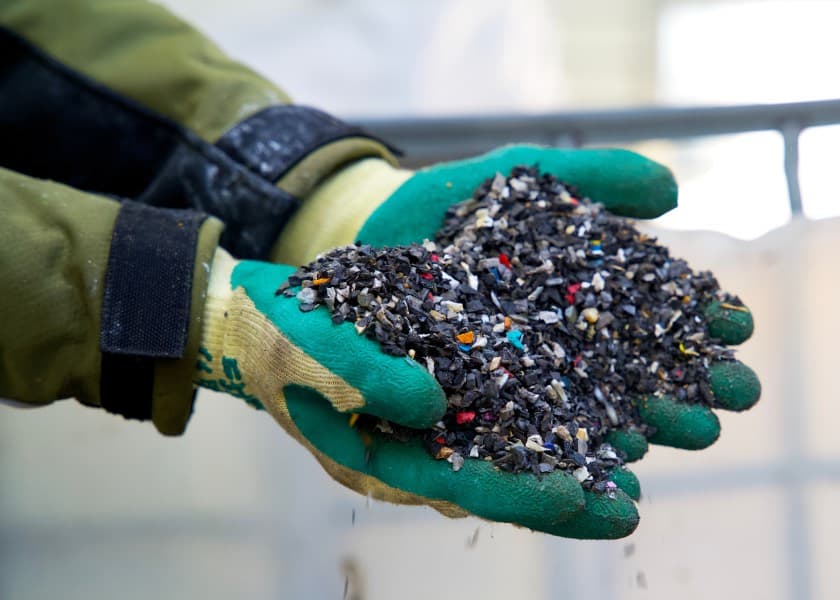
- Grinding into flake.
- Washing, only if there's dirt or residue.
- Extrusion and pelletizing with melt filtration, or direct use of the regrind.
The result goes back to market as raw material for processors that mold, extrude or thermoform. The cleaner and more uniform the incoming material, the fewer steps it needs and the better the final product.
How to identify and sort PS in your plant
Plants handle trays in several materials that look very similar: PS, PET, PVC and PP. Mixing them lowers the value of the whole lot. These clues help you sort them:
- Resin code: look for the number inside the triangle; 6 is PS.
- Bend test: crystal PS snaps with a clean break; HIPS bends slightly and whitens at the fold before breaking; PP bends without breaking.
- Float test: useful for solid material, not foam.
| Material | Code | When bent | In water | In saturated salt water |
|---|---|---|---|---|
| PP | 5 | Flexible, hard to break | Floats | Floats |
| PS (crystal or HIPS) | 6 | Rigid; HIPS whitens | Sinks | Floats |
| PET | 1 | Rigid and tough | Sinks | Sinks |
| PVC | 3 | Rigid | Sinks | Sinks |
These are field checks for day-to-day sorting. When in doubt, or when large volumes are at stake, confirm in a lab, for example with infrared spectroscopy. For a refresher on every code, see our guide to types of recyclable plastic.
What recycled polystyrene is used for
- Thermoformed trays for industrial, non-food use.
- Office and school supplies, such as rulers and pen components.
- Clothes hangers.
- Planters and garden accessories.
- Moldings, picture frames and decorative profiles that imitate wood.
- Non-structural injection-molded parts and housings.
- Insulation boards, from EPS or XPS.
Food-contact packaging requires specific recycling processes and approvals, so most recycled PS goes into non-food uses.
Buying recycled PS: what to ask your supplier
If you're a processor looking at recycled polystyrene as a feedstock, confirm these points before you buy:
- Type: HIPS or crystal PS, not a mix. HIPS retains impact resistance better; crystal PS is stiffer and more brittle.
- Melt flow index: for PS it's commonly measured at 200 °C with 5 kg. Compare it with the grade you run today, under the same conditions.
- Format: regrind or pellets. Pellets feed more consistently in injection molding and sheet extrusion.
- Color and contamination: base shade, any conductive black material in the mix and the level of black specks.
- Source: single-source post-industrial material is always more predictable than mixed post-consumer streams.
- Lot documentation: a certificate per lot, so you can trace any issue back to its source.
PS isn't hygroscopic, but regrind can carry surface moisture if it was stored outdoors; a light drying step prevents bubbles and splay on the part.
What determines the value of recycled polystyrene
Without getting into prices, which move with the market, these are the factors that drive the value of your material:
- Purity: separated HIPS or crystal PS is worth more than mixed types or PS mixed with other plastics.
- Color: natural, clear or white has more outlets than mixed colors; conductive black has a narrower market.
- Cleanliness: no labels, tape, staples or residue.
- Shape and density: stacked, strapped or ground trays cost less to haul than loose material. Loose EPS foam is the extreme case, which is why it's usually compacted or densified.
- Volume and regularity: a steady stream makes collection and processing easier to plan.
The recycled PS market: challenges and opportunities
Polystyrene recycling gets less attention than PET and faces real hurdles: low-density foam makes logistics expensive, and much post-consumer PS is contaminated with food. That's why the most attractive stream is post-industrial: clean, single-type trays generated at a steady volume, exactly what many manufacturing plants produce.
For your company, the opportunity has two sides. First, stop paying to dispose of trays as trash and turn them into a material with value. Second, build trays into a return loop with your suppliers so reusable ones keep circulating and only damaged ones get recycled. Reverse logistics is the discipline that organizes that loop.
A basic plan for your plant:
- Set up a dedicated collection area for trays, separated by material and color.
- Remove labels and tape at the point of generation, not at the end.
- Stack and strap trays to reduce volume.
- Agree with suppliers on which trays go back and which get recycled.
- Schedule pickups based on the volume you actually generate.
How Zikloa can help
Zikloa recycles industrial plastics, including polystyrene, and can collect the trays your plant generates. Polystyrene trays are also part of our raw materials catalog for processors looking for this material as a feedstock. Tell us how many trays you generate and what type they are so we can review the best collection or supply option.
- #recycled polystyrene
- #polystyrene trays
- #hips
- #industrial plastics
- #packaging waste
Frequently asked questions
Is EPS foam recycled the same way as a rigid polystyrene tray?
Both are polystyrene, but EPS foam is mostly air, so it has to be compacted or densified before transport makes sense. Rigid trays can be ground directly, which makes them much easier to handle.
What's the quickest way to tell a PS tray from a PET tray?
Check the resin identification code: 6 means PS and 1 means PET. If there's no code, a float test gives a good indication, and for doubtful cases or large volumes a lab confirmation is worth it.
Can recycled polystyrene be used in food packaging?
Only through recycling processes and approvals specific to food contact. Most recycled PS goes into non-food applications such as industrial trays, office supplies and decorative moldings.